

ASEAN and New Zealand Forge a Comprehensive Strategic Partnership: What It Means
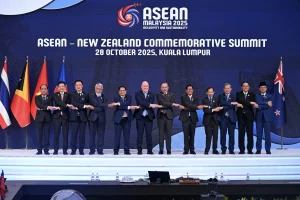
The Southeast Asian bloc ASEAN and New Zealand have elevated their relationship by agreeing to establish a Comprehensive Strategic Partnership (CSP). This new pact marks a significant upgrade in their cooperation, covering security, trade, digital economy, climate action and people-to-people connectivity. The partnership signals deeper alignment at a time of global uncertainty and regional shifts.
Why this upgrade matters
New Zealand regards ASEAN as one of its most important partners in the Indo-Pacific. With ASEAN representing roughly 700 million people and a collective economy of multiple trillions of dollars, New Zealand’s decision to deepen ties is both strategic and timely.
The CSP formalises ambitions beyond standard diplomacy — it embeds long-term cooperation on shared priorities:
-
Peace & security (maritime, cyber, organised crime)
-
Prosperity (trade, investment, digital economy)
-
People & skills (mobility, education, workforce)
-
Planet (climate resilience, sustainable development)
For ASEAN, the upgrade offers a stronger link to a trusted middle-power, access to services and innovation, and another support pillar amid great-power competition.
What the agreement includes
Key elements of the CSP include:
-
A Plan of Action for 2026-2030, aligning the partnership to practical initiatives, measurable goals and review mechanisms.
-
Support for trade liberalisation and economic integration, working through mechanisms such as AANZFTA and RCEP to boost business ties.
-
Strengthened cooperation on maritime and border security, data flows, cyber resilience and counter-transnational-crime capacity building.
-
Initiatives for people-to-people links: vocational training, exchange programmes, professional mobility and youth engagement.
-
Shared environmental agenda: green finance, blue economy, climate-smart technologies and sustainable infrastructure.
These components move the relationship into a framework that embeds strategic, economic and societal dimensions — far beyond periodic diplomatic visits.
Implications for business and trade
For businesses in the region, the CSP unlocks new opportunities:
-
Firms in ASEAN states gain improved access to New Zealand’s market and services;
-
New Zealand companies gain a stronger platform into ASEAN’s manufacturing and consumer markets;
-
Supply chain players can leverage new policies, trade facilitation and regulatory alignment to scale regional operations;
-
Sectors such as agribusiness, education services, digital tech and logistics are particularly poised to benefit.
Moreover, the emphasis on green and digital value-chains aligns with emerging investment trends. Businesses that act early may capture first-mover advantage.
A timely development amid global shifts
The timing of the upgrade is notable. The Indo-Pacific region faces intensified strategic competition, supply-chain realignment and climate risks. ASEAN’s ambition to remain central in regional architecture means deeper links with partners like New Zealand are critical. The CSP reflects both sides adapting to a changing global context — one where security, sustainability and technology converge.
What regional players should watch
-
Implementation matters: Plans are ambitious; success depends on how well coordination, monitoring and financing mechanisms deliver.
-
Regulatory and policy alignment: For businesses, clarity over rules, standards and customs will determine impact.
-
Climate & sustainability action: How the “Planet” pillar translates into investment, standards and trade will test the partnership’s depth.
-
People mobility and skills: If education/training links scale, they could shift workforce capabilities region-wide.
-
Geopolitical balance: Both ASEAN and New Zealand must navigate relationships with major powers while preserving the strategic independence of the partnership.
Final thoughts
The upgrade to a Comprehensive Strategic Partnership marks a new chapter in ASEAN-New Zealand relations. It reflects recognition that global challenges — from environmental crises to digital disruption to regional security — require deeper, more integrated cooperation. For governments, investors and business leaders, the CSP opens fresh pathways. The question now shifts from intent to delivery: how the promises of cooperation translate into tangible results for economies and societies across the region.
Read more:
Dịch vụ gửi rong biển khô đi New Zealand qua NZ.POST
Dịch vụ mua hộ quần áo từ Đài Loan về Việt Nam
